

 Deutsch
 English
 Español
 Français
Co-Extrusion in Elastomers: Design, Function, and Precision in Silicone and Rubber

In today's world of advanced manufacturing, where the demand for specialized technical products like medical tubing, custom cables, and complex automotive profiles is constantly growing, co-extrusion of elastomers has emerged as a critical technology. This innovative process enables the combination of multiple materials into a single, seamless piece, optimizing performance, reducing costs, and enhancing design possibilities.
What is Co-Extrusion?
Co-extrusion is a manufacturing process where two or more compatible materials are extruded through a single die, resulting in a single piece with multiple layers or components, without the need for additional bonding agents. This is particularly useful when different parts of a product need to have different properties. In the realm of elastomers, this opens up a world of possibilities.
Why is Co-Extrusion Necessary?
Co-extrusion is essential because it allows manufacturers to unite materials with distinct properties, achieving functionalities that would be impossible with a single compound. Key advantages include:
- Integration of Differentiated Functional Zones: Create flexible, resistant, insulating, or visible areas within a single product.
- Product cost optimization: combining cost‑effective base carriers with high‑end, high‑cost functional layers.
- Elimination of Assembly or Gluing Processes: Streamline production by creating complex parts in one go.
- Emission reduction: reducing emissions through adhesive savings is a key factor for greater sustainability in industry.
- Enhanced Geometric Precision and Product Repeatability: Ensure consistent quality and accuracy in every piece.
- Reduced Waste and Improved Line Efficiency: Minimize material waste and optimize the production process.
Example: Consider a medical tube that must be X‑ray visible, biocompatible, single‑piece without detachable components, and equipped with external markings. Co‑extrusion enables the integration of all these properties into a single, co‑extruded component.
The Co-Extrusion Process: Equipment and Layout
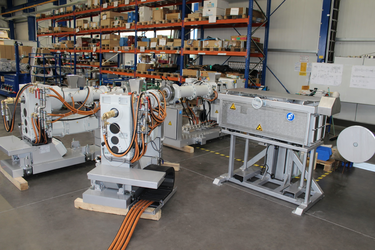
A typical co-extrusion line for silicone or rubber includes:
- Independent Extruders: Usually 2 to 4, each with regulated motors, specific screws, and segmented heating zones.
- Custom-Designed Co-Extrusion Head: Engineered for laminar flow, layer adhesion, and dimensional stability.
- Auxiliary Systems: Gear pumps, vacuum systems, composite material feeders, support air controls, continuous vulcanization (using heat, infrared, or microwaves), and automatic cutting, single‑ or multi‑dimensional measuring systems.
The Role of Physical Space
The plant layout should consider:
- Angular Orientation of Extruders: Options include T, 60°, 90°, and 120° configurations.
- Unit Mobility: Some units (like the head) should be fixed, while others should be movable for easy cleaning and quick changes.
- Line Length: Production lines can extend between 40 and 60 meters, incorporating cooling, vulcanization, and dimensional control.
Movement Systems: Ergonomics and Precision
Extruder mobility is key for cleaning, maintenance, and process repeatability. Available options include:
- Linear Rails: Provide mechanical robustness and controlled manual or motorized movement.
- Air-Cushion: Enables fluid, effortless movement with minimal mechanical wear.
- Vertical Mounting: Offers stable gravitational flow and reduces lateral space occupation.
Optimal Design: Mobile extruders with mechanical locking, position sensors, and integrated guides ensure alignment while maintaining the properties of the final products.
Raw material feeding and pumping: flow stability
A reliable feeding system prevents downtime and ensures consistency:
- Automatic strip feeders
- Metal detectors
- Controlled Dosing by Weight or Volume
- Synchronized Multi-Component Systems
Gear Pumps
These pumps guarantee:
- Accurate Volumetric Flow Independent of the Head
- Greater Stability in Material Proportions
- Reduced Impact from Pressure or Temperature Variations
Tooling: Applied Engineering for Functional Design
The co-extrusion head and its tools define:
- The Final Profile Geometry
- The Distribution of Flows without Turbulence or Migration Between Layers
- Adhesion Zones and Homogeneous Curing
Critical Application: An automotive profile may include foam zones, solid lips, and mounting interfaces, each designed into the tooling based on desired tolerances and functionality.
Real-World Examples of Advanced Co-Extrusion
Product | Combined Functions | Reason for Co-Extrusion |
|---|---|---|
| Metal Edge Protector | Metal + Rubber for Impact Absorption and Fastening | A single material cannot fulfill both functions |
| Medical Catheter | Silicone + Radiopaque Band + External Marking | Combination of visibility, biocompatibility, and function |
| Turbo Charger Hose | High Thermal Resistance + Reinforcement + Chemical Resistance | Extreme conditions require specialized layers |
| Silicone Cable | Electrical Insulation + Flexibility + Fire Resistance | Multifunctional protection in harsh environments |
| Automotive Anti-Pinch Sensor | Elastic Profile + Active Signal Component | Co-extrusion integrates mechanical and electrical functions into a single body |
| A/C Hose with Removable Core | Multi-Layer Structure + Removable Element for Vulcanization | Temporary support during the process without affecting the final product |
| Complex Automotive Profile | Varied Geometries + Distinct Physical Properties (Sealing, Mounting, Aesthetics) | Impossible to achieve by simple extrusion |
Innovation and Sustainability
Modern co-extrusion is advancing towards:
- Recyclable and Biocompatible Materials
- Integration of Sensors and Online Control
- Modular Tooling Systems for Quick Adaptations
Conclusion:
Co-extrusion of elastomers is a powerful technique driving innovation across various industries. By combining materials with different properties, manufacturers can create products that are more functional, efficient, and sustainable. As technology continues to advance, we can expect even more innovative applications of co-extrusion to emerge, shaping the future of product design and manufacturing.
Call to Action:
Are you ready to explore the possibilities of co-extrusion for your next project? Contact us today to learn how we can help you optimize your designs and processes.