

 Deutsch
 English
 Español
 Français
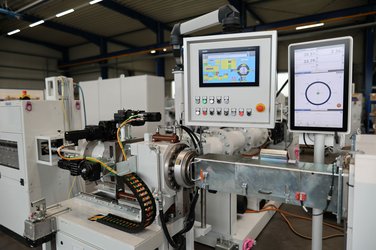
New generation of the crosshead Q 35/125 VH R SO - PLC-regulated wall thickness adjustment with X-ray centring!

The demands on quality and efficiency in the production of rubber and silicone hoses are increasing continuously: constant cross-sections, uniform wall thicknesses, complete traceability, and minimal downtimes during changeovers are decisive competitive advantages today.
The new crosshead type Q 35/125 VH‑R‑SO offers an automated solution that reduces manual intervention and stabilizes production.
What is the Q 35/125 VH‑R‑SO? The Q 35/125 VH‑R‑SO is the new generation of the crosshead for hose extrusion. Its essential feature is an electromechanical wall thickness adjustment controlled by a PLC, combined with a separate X-ray measuring unit for online measurements. The connected units enable the automatic adjustment of wall thickness and centring of the hose during the ongoing process, as well as the storage of measurement data with production timestamps and OK or NOK according to tolerance specifications.
Technical Highlights
- PLC-regulated electromechanical adjustment: Precise and reproducible positioning of the die sleeve (pinole) for fine adjustment of the wall thickness and the center of the hose. Automatic control loops minimize operator intervention.
- X-ray measuring system integrated directly into the process: Continuous digital recording of the wall thickness and the inner layer (centring) of the hose. The measurement data serve as actual values for the PLC control.
- Online control: Measured values are transmitted to the PLC in real time; deviations from the setpoint are corrected immediately (axial vertical and horizontal).
- Improved traceability: Digital storage of measurement and control values for batch traceability, quality documentation, and process optimization.
- Reduced downtimes: No manual readjustments after tool changes, material fluctuations, or temperature changes — the system adapts independently.
- Integration into production lines: The control and regulation solution can be integrated into existing automation systems and central monitoring.
Production Benefits
- Higher product quality: Constant wall thicknesses and improved centring reduce scrap and rework.
- Increase in efficiency: Fewer operator interventions, shorter setup times, and fewer production interruptions.
- Process stability: Automatic compensation of fluctuations (material, temperature, pressure, line speed) ensures reproducible results.
- Data-driven decisions: Stored measurement and control values form the basis for process analyses, predictive maintenance, and continuous improvements.
- Flexibility: Can be used for various types of hoses (brake lines, hydraulics, fuel, air conditioning systems, turbochargers, etc.).
Correction Strategies and Application Examples
The functional principle of the motorized centring system is based on a very sensitive radial swivelling of the inner tools of the head (mandrel and pinole). This mechanism enables precise and fast corrections of the radial centring and wall thickness over the entire circumferential length of the hose.
- Horizontal wall thickness deviation: Through lateral movement of the pinole (action in Y) to shift the inner diameter and restore symmetry.
- Vertical wall thickness deviation: Through proximal adjustment via the pinole (action in Z) to correct centre-of-gravity shifts and restore symmetry.
- Inclined deviations: Coordinated combination of lateral and proximal adjustments (simultaneous Y and Z actions) for asymmetrical corrections and restoration of the uniform profile.
- Fine wall thickness correction: Axial displacement of the pinole to remedy minor wall thickness deviations in the X direction as a supplement to the corrections already mentioned.
Integration and Operation Operation takes place via the PLC, in which the setpoints are configured. The X-ray unit continuously supplies the actual values. The system can be supplemented with remote maintenance functions and central monitoring for support and diagnostics, thus complying with rubicon's service and remote control solutions.
Conclusion: The rubicon crosshead Q 35/125 VH‑R‑SO combines flow dynamics for elastomers with precision mechanics, advanced measurement technology, and intelligent control in a single solution that reduces manual interventions and stabilizes extrusion processes. For hose manufacturers, this means less scrap, higher product quality, and better traceability — with a corresponding increase in the cost-effectiveness of the production line.
For technical details, adaptations to your line, or live demos, please contact the manufacturer. rubicon also offers after-sales service, process development, and integration into existing lines.
